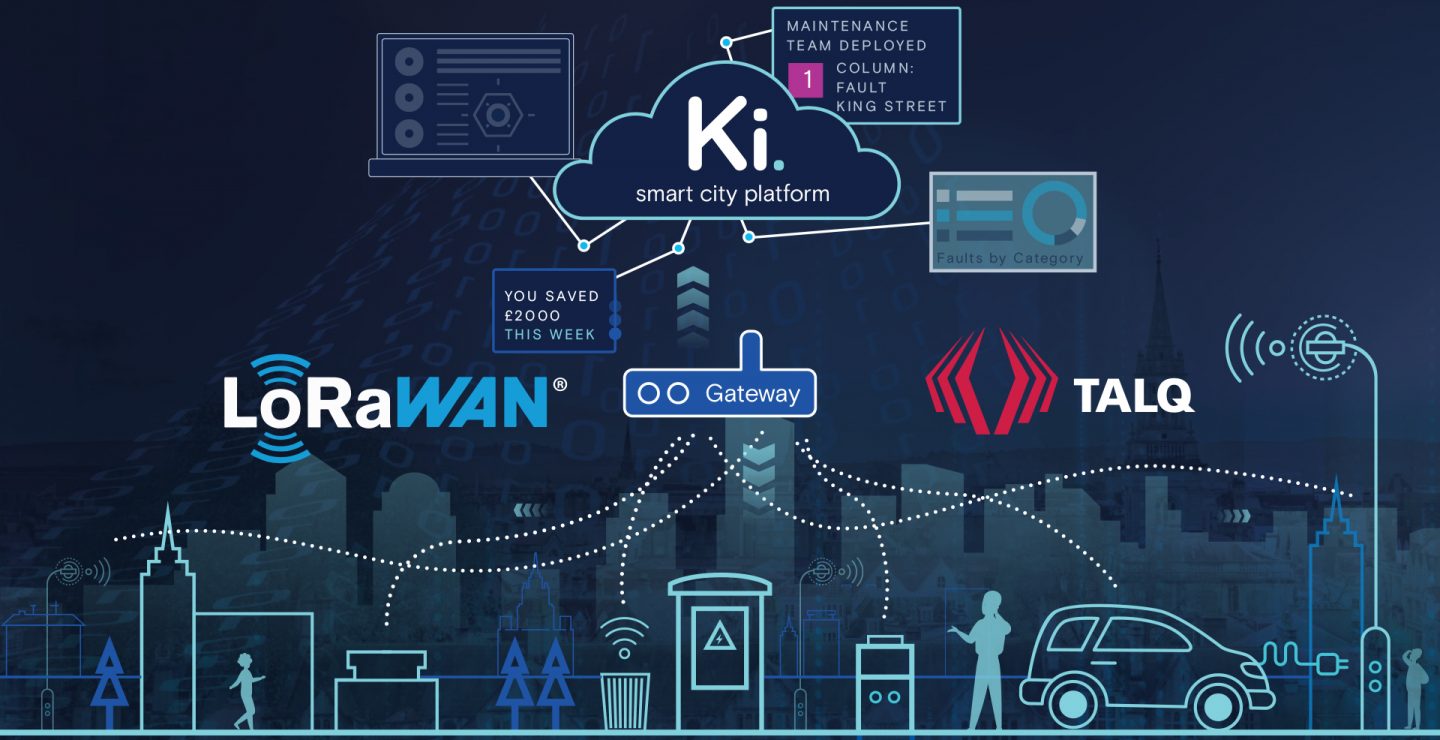
As towns and cities become more connected, the role of highways infrastructure is expanding rapidly. Street lighting columns, feeder pillars and other highways assets are no longer just physical structures. They are becoming platforms for sensors, monitoring systems and data-driven services.
Behind every connected device sits a communication network. For many smart infrastructure projects, two Low-Power Wide-Area Network (LPWAN) technologies dominate the conversation: NB-IoT and LoRaWAN.
Both offer reliable ways to connect low-power devices across large areas. However, each technology has different strengths, and selecting the right one can have a significant impact on long-term performance, cost and scalability.
Understanding how these networks differ is essential when planning smart city infrastructure.
Understanding LPWAN Connectivity
LPWAN technologies are designed to connect devices that transmit small amounts of data over long distances while consuming very little power.
This makes them ideal for smart city applications such as:
- Street lighting monitoring and control
- Drainage and gully monitoring
- Air quality sensing
- Waste bin monitoring
- Asset tracking across highways networks
Two of the most widely adopted LPWAN technologies are NB-IoT (Narrowband Internet of Things) and LoRaWAN (Long Range Wide Area Network).
While both serve similar purposes, the way they operate is fundamentally different.
What is NB-IoT?
NB-IoT operates on licensed cellular spectrum, typically using existing LTE (Long Term Evolution) mobile networks. This means devices communicate through telecom operators in much the same way as mobile phones.
Because it uses established cellular infrastructure, NB-IoT offers several advantages:
- Reliable, carrier-grade connectivity
- Strong penetration in dense urban environments
- Good performance for indoor or underground installations
- Higher data throughput compared with many LPWAN technologies
These characteristics make NB-IoT well suited to applications where reliable connectivity is required in challenging environments, such as basements, underground infrastructure or densely built urban areas.
However, NB-IoT deployments are typically dependent on mobile network coverage and operator agreements, which can introduce ongoing connectivity costs.
What is LoRaWAN?
LoRaWAN operates on unlicensed radio spectrum, allowing organisations to deploy either public or private networks.
Instead of relying solely on mobile operators, LoRaWAN devices connect through gateways that transmit data to network servers and applications.
This architecture brings several key advantages:
- Long communication range, often several kilometres
- Extremely low power consumption, enabling long battery life
- Flexible deployment through public or private networks
- Lower connectivity costs in many deployments
These characteristics make LoRaWAN particularly effective for connecting large numbers of distributed sensors that send small amounts of data infrequently.
In recent deployments, local authorities have begun using LoRaWAN networks to support a growing range of environmental and infrastructure monitoring applications alongside existing lighting assets.
Key Differences Between NB-IoT and LoRaWAN
While both technologies support large-scale IoT deployments, their strengths differ across several important areas.
Network infrastructure
- NB-IoT uses licensed cellular networks operated by telecom providers
- LoRaWAN operates on unlicensed spectrum and can be deployed as public or private networks
Coverage and range
- NB-IoT provides strong coverage through cellular towers and excels in dense urban environments
- LoRaWAN offers long-range connectivity, typically several kilometres depending on terrain
Battery performance
- NB-IoT devices are energy efficient but require periodic cellular network communication
- LoRaWAN devices are optimised for ultra-low power operation and can often operate for many years on a single battery
Data transmission
- NB-IoT supports higher data throughput and lower latency
- LoRaWAN is designed for small, infrequent data packets rather than continuous transmission
Deployment cost
- NB-IoT typically requires SIM-based connectivity and operator subscriptions
- LoRaWAN deployments can operate through private infrastructure, potentially reducing long-term costs
Why Ecosystem Matters for Smart Cities
While technical performance is important, one factor increasingly shaping network choice is ecosystem maturity.
LoRaWAN has grown rapidly in recent years due to the strength of its global device ecosystem. Through platforms such as The Things Network, thousands of compatible sensors and connected devices are now available.
These include sensors for:
- Air quality monitoring
- Waste bin management
- Drainage and flood monitoring
- Pedestrian footfall analysis
- Environmental data collection
- Asset tracking
This breadth of compatible hardware allows local authorities to start with a single application, such as street lighting control, and gradually expand into wider smart city services using the same infrastructure.
In many cases, the lighting column becomes the ideal mounting point for additional sensors. This allows existing asset networks to evolve into platforms for environmental monitoring, mobility data and operational insight. In other words, the network becomes a foundation for future digital infrastructure.
Choosing the Right Network for Your Application
Both NB-IoT and LoRaWAN have important roles in modern smart infrastructure, and in many cases the best approach is not choosing one over the other but selecting the most appropriate network for each application.
NB-IoT may be the right choice when:
- Devices are in dense urban environments or underground spaces
- Higher data throughput is required
- Existing cellular infrastructure is preferred
LoRaWAN is often well suited when:
- Long battery life is critical
- Large numbers of distributed sensors are required
- Organisations want flexibility to deploy private networks
- Cost-effective scaling across multiple applications is important
Understanding the operational requirements of each project is key to selecting the right technology.
Real-World Deployment Strategies
In practice, many connected infrastructure projects do not rely on a single network technology.
Instead, different applications are often supported by different connectivity options depending on their operational requirements.
For example, a local authority may use LoRaWAN to support large numbers of distributed sensors across a highways network such as drainage monitoring, environmental sensors or asset tracking where long battery life and low power consumption are essential.
At the same time, NB-IoT may be used for applications that benefit from cellular infrastructure, such as installations located in dense urban environments or underground locations where deep signal penetration is required.
Taking this approach allows organisations to match each application to the most suitable network while building a flexible, future-ready digital infrastructure.
As Ryan Baum, Smart City Specialist at Lucy Zodion, explains:
“The question isn’t which technology is better. It’s which technology best fits the application. In many cases the most effective smart infrastructure strategies use both networks together.”
This pragmatic approach is becoming increasingly common as local authorities expand beyond lighting control into wider smart city services.
Supporting Connected Infrastructure Strategies
As infrastructure becomes more connected, the ability to integrate multiple technologies becomes increasingly valuable.
At Lucy Zodion, our Ki. smart city platform supports connected infrastructure strategies that allow local authorities to manage lighting assets while enabling wider IoT applications.
Whether monitoring environmental conditions, improving operational efficiency, or supporting future smart city services, the focus remains the same: ensuring the underlying infrastructure can evolve as new opportunities emerge.
Building Networks That Enable the Future
The choice between NB-IoT and LoRaWAN is not simply a technical decision. It is part of a broader strategy for how infrastructure will support connected services in the years ahead.
Both technologies have clear strengths. However, the growing ecosystem surrounding LoRaWAN is making it an increasingly attractive option for organisations looking to build scalable smart infrastructure.
Ultimately, the most successful projects start with a simple question:
What does the application need to achieve, and which network will support that goal best?